
The benefits of MPAs highlighted on RTÉ Radio 1’s CountryWide
16/12/2025
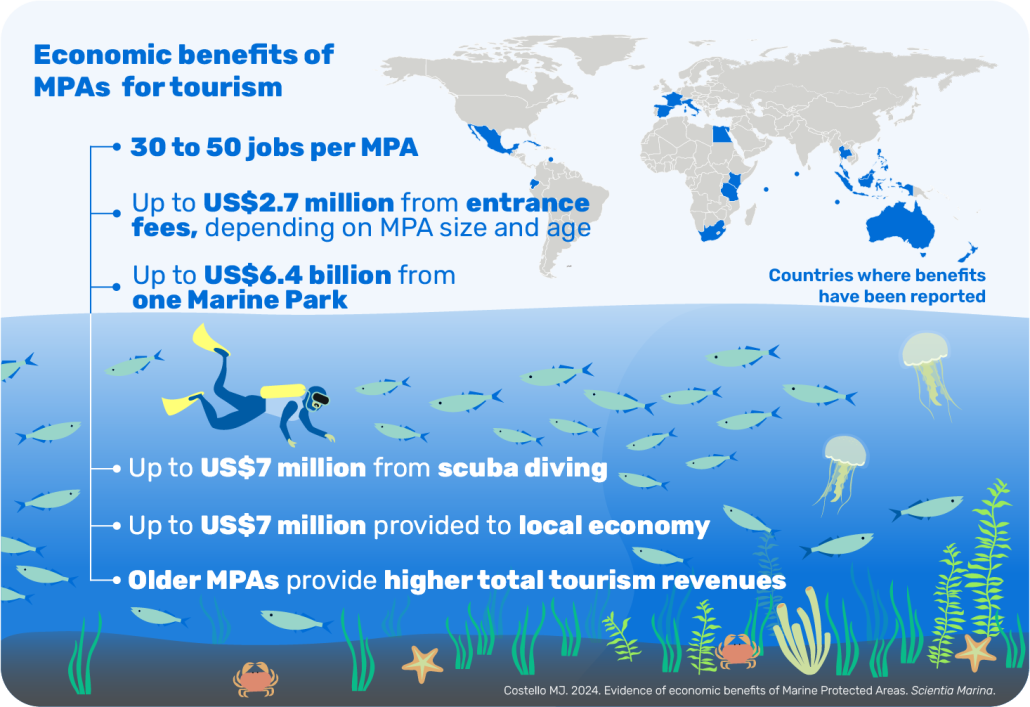
On 15 November 2025, Ireland’s national public broadcaster RTÉ devoted the first minutes of its CountryWide show to a discussion on marine protected areas (MPAs). The segment featured MPA Europe’s coordinator, Mark Costello, who outlined recent evidence on how MPAs can bring both ecological and economic gains.
Drawing on a global dataset of 50 established MPAs across 31 countries, Mark Costello argued that, contrary to widespread assumptions, MPAs do not necessarily lead to lost fishing opportunities. On the contrary, when properly designed and managed, MPAs can yield long-term benefits for fish stocks, and therefore for fishing communities, by allowing ecosystems to recover and regenerate.
Mark Costello also highlighted that the economic value of MPAs is not limited to fisheries alone: tourism, recreation, and ecosystem services contribute significantly to local economies. Protection of marine areas under a robust conservation framework can deliver stable livelihoods and sustainable use, a point that resonates strongly with the MPA Europe approach, which integrates biodiversity, socioeconomic and climate‑change data to identify optimal protection areas across European seas.
He also stressed a broader policy and societal message: the benefits of MPAs need to be understood beyond short‑term interest — MPAs are an investment into ecological resilience, future fisheries stability, and sustainable coastal economies. Public awareness and clear communication, alongside properly enforced protection, are essential to realise those benefits.
A week later, Mark gave a similar message to the national news on TV in Norway about the struggle to really protect marine life in the Saltstraumen MPA in Norway. Following the MPA Europe conference in Bodø (including a field trip to Saltstraumen), public calls have led to calls from several political parties to increase protection in the MPA. The MPA currently has exceptionally high fishing, predominantly from tourists, and perhaps the highest fishing pressure and amounts of lost lines, hooks and lead weights in Norway.
As the European Union and many countries work towards ambitious ocean conservation goals, this interview reinforces the rationale for science-based MPA design and management. MPA Europe welcomes such public discussion as a means to strengthen support for effective marine protection — not only as a nature‑conservation measure but as a strategy for sustainable blue economies and resilient marine ecosystems.


