
MPA Europe Releases Policy Brief on Biodiversity, Organic Carbon, and Marine Spatial Planning
28/05/2026
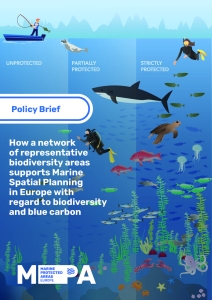
MPA Europe has released a new policy brief outlining how representative networks of Marine Protected Areas (MPAs) can support Marine Spatial Planning (MSP) in Europe, with a focus on biodiversity protection and organic carbon.
The policy brief brings together scientific results from the project and feedback received through MPA Europe’s stakeholder engagement process. As part of this process, MPA Europe held eight online and hybrid stakeholder-dedicated workshops, two for each European sea basin covered by the project, for which reports are available: the Baltic Sea, Black Sea, Mediterranean Sea and North-East Atlantic. These interactions, together with a series of stakeholder FAQs addressing recurring questions on data, modelling, climate change, MPA designation and planning needs, and a final report on four regional case studies synthesising stakeholder views, provided important input for the development of the policy brief.
The brief highlights why coherent MPA planning is needed now. Although Europe has made progress in expanding nominal MPA coverage, many existing protected areas do not yet form an ecologically coherent network, and some still allow activities that are not compatible with biodiversity conservation. At the same time, marine space is under increasing pressure from renewable energy, fisheries, shipping, aquaculture, and tourism.
MPA Europe’s analysis integrates around 14 million species occurrence records and environmental variables from the sea surface to the seabed. Using these data, the project modelled the distributions of more than 12,000 marine species at approximately 5 km resolution. The resulting Representative Biodiversity Area network identifies areas that collectively capture marine biogeographic provinces, mapped ecosystems, habitat-forming species, and threatened species across European seas.
The policy brief also presents findings on seabed organic carbon. MPA Europe compiled and modelled sediment organic carbon content across European seas using the EURO-CARBON database. The results show that high carbon stores are concentrated in areas such as fjords, estuaries, and Mediterranean Posidonia seagrass meadows. Because areas of high biodiversity and high carbon storage do not always overlap, the brief recommends that MSP considers biodiversity protection and restoration, and carbon safeguarding, as separate but complementary spatial objectives.
A central outcome of the policy brief is a set of 10 recommendations for improving how MPAs are planned, managed, and integrated into MSP. The first three recommendations are to: prioritise the 10% and 30% Representative Biodiversity Areas for increased protection and habitat restoration; prioritise action on strictly protected MPAs, as strict protection is most effective for ecological restoration and fisheries benefits; and determine new MPA designations with local communities and stakeholders, with boundaries and management informed by local knowledge, social values and ecological evidence.
The remaining recommendations address SMARTIE goals for marine biodiversity protection, stronger coordination through Regional Seas Conventions, the use of international MPA standards, restrictions on activities that damage habitats or disturb high-carbon seabed areas, regular training and communication for Member States, and improved publication of species, environmental, and sampling data through standardised European and Global repositories such as EMODnet, OBIS, and GBIF.
The draft recommendations were first presented at MPA Europe’s policy-focused meeting in Brussels on 4 February 2026, co-hosted with DG Environment. The meeting brought together representatives from DG MARE, DG RTD, national government policy authorities, non-governmental organisations, Regional Sea Conventions, research institutions, and the Technical Expert Group on Data for MSP. Feedback was collected during the meeting and through a dedicated consultation period over the following month, helping the project team refine the final policy brief into a practical resource for stakeholders involved in MPA planning and MSP.
A short, concise version of the policy brief will be distributed as a printed copy at the World Ocean Week Conference 2026, organised by FAIR SEAS and taking place on 3rd June at Cork City Hall, where MPA Europe will be represented by project partner Climazul. A full version of the policy brief will be available online providing further details on the evidence, stakeholder input, and recommendations.


